
“Food-Grade” Isn’t One Standard — It’s Whichever One Your Customs Officer Checks
We saw a version of this play out with a buyer shipping silicone feeding spoons into Spain. The spoons were sourced as LFGB-material silicone — the right spec, ordered correctly. Around December 2023, the batch came back over the LFGB VOC limit anyway.
That’s the pattern we see most often: it’s rarely that a buyer ordered the wrong grade of silicone. It’s that “LFGB material” on a spec sheet and “this specific batch actually passes LFGB testing” are two different things, and the gap between them tends to surface at the worst possible moment — after production, sometimes after the goods are already in transit.
Our own QC lead, Gao, traced that particular failure back to the manufacturing floor. Her team found that the supplier had quietly shortened the post-curing (baking) step to save on electricity — the silicone was genuinely platinum-cured, nothing had been substituted, but the shorter bake left residual volatiles trapped in the material. It passed a visual inspection and even a basic sniff test at room temperature. It only showed up when the finished batch went through formal VOC testing.
“People think platinum-cured silicone is a magic bullet for LFGB,” Gao told our team during that batch review. “It isn’t. Platinum curing gets you 80% of the way there, but if the oven operator cuts the baking cycle from 4 hours down to 2 just to hit their energy target, those residual volatiles stay trapped inside. It looks fine, smells fine in the office, and still fails VOC testing. The material matters, but the oven clock matters just as much.”
The lesson her team took from it: platinum curing is necessary for LFGB compliance, but it’s not sufficient on its own — the post-curing process has to be verified too, not assumed. (If you’re vetting a new supplier and want the fuller list of things to check before you commit, our buyer’s risk-prevention checklist for sourcing silicone from China covers this in more depth.)
1. What Are FDA and LFGB Silicone Standards?
FDA Silicone Standard (North America Entry Benchmark)
- Primary Markets: United States, Canada, and Latin America
- Legal Basis: US FDA 21 CFR 177.2600, governing food-contact rubber articles
- Curing Method: Accepts either conventional peroxide curing or liquid platinum curing
- Chemical Testing: Standard extraction limits using n-hexane and distilled water
- Sensory & VOC Rules: No mandatory odor/taste evaluation; standard volatile limits
- Cost Structure: Cost-effective for mass-market retail and high-volume wholesale
LFGB Silicone Standard (EU Premium Benchmark)
- Primary Markets: Germany, France, Switzerland, Austria, UK, and premium EU retailers
- Legal Basis: German LFGB code, based on BfR Recommendation XV (Bundesinstitut für Risikobewertung)
- Curing Method: In practice, compliant products are almost always liquid platinum-cured — this isn’t spelled out word-for-word in the regulation, but platinum curing is the industry-standard route to reliably pass LFGB’s sensory and VOC testing
- Chemical Testing: Multi-simulant migration testing (acetic acid, ethanol, olive oil) to mimic real cooking conditions
- Sensory & VOC Rules: Mandatory sensory panel test (no detectable chemical taste/odor) plus a strict volatile substance limit of 180°C / ≤0.5%
- Cost Structure: Typically 15–30% higher in material and testing cost than FDA-only silicone
2. Key Technical Differences Impacting B2B Buyers
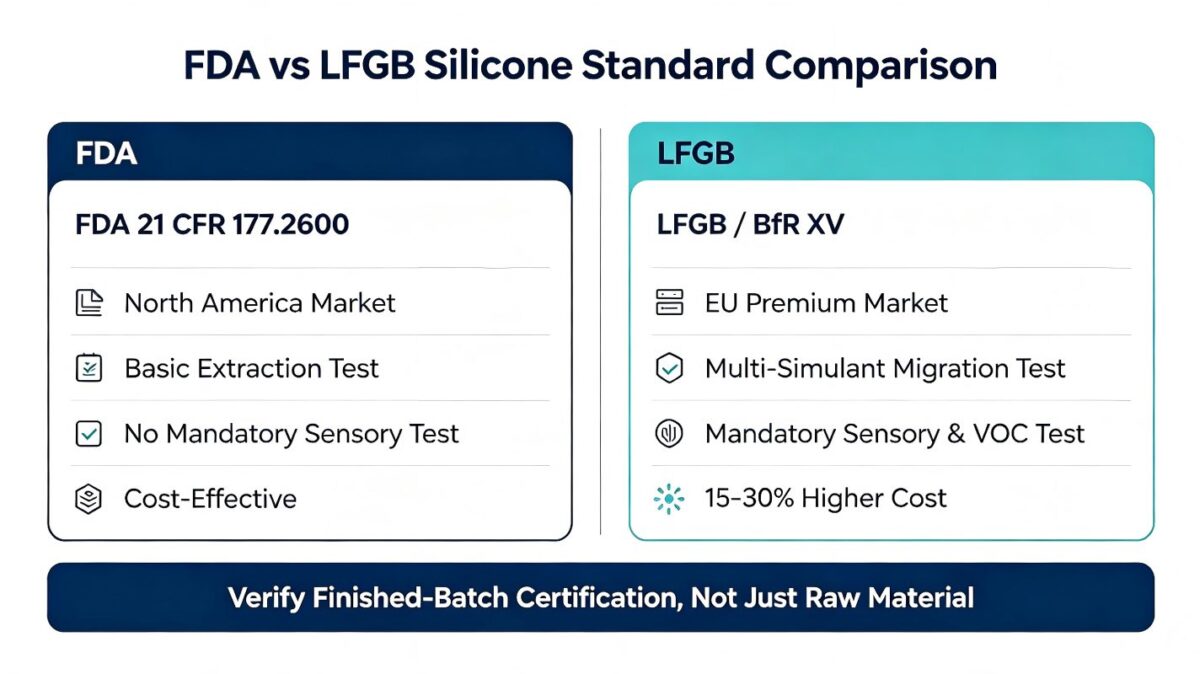
FDA testing relies on basic extraction using n-hexane and distilled water. LFGB goes further, simulating real-world cooking conditions with acidic (acetic acid), alcoholic (ethanol), and fatty (olive oil) food simulants over extended exposure times — the goal being to catch migration that a basic extraction test would miss entirely.
Sensory testing is where the two standards diverge most sharply, and it’s also where Gao’s team sees the most avoidable batch failures. FDA doesn’t require a formal odor/taste evaluation. LFGB does — a trained panel checks for any detectable chemical odor or taste transfer, and it’s assessed independently of the chemical migration results. A product can pass every migration test and still fail on sensory alone, which surprises a lot of first-time LFGB buyers.
As for curing method: LFGB is written around performance limits (the 0.5% VOC threshold, the sensory panel outcome), not around “you must use platinum curing” as a literal legal requirement. In practice, though, peroxide-cured silicone essentially never passes LFGB’s combination of tests, so platinum curing has become the de facto standard for anything LFGB-bound. Platinum curing avoids the reactive byproducts that peroxide curing leaves behind, resists yellowing over time, and — when post-cured properly — is what actually gets a batch through the sensory panel.
3. How to Choose the Right Certification for Your Orders
Choose FDA Certification if:
- You’re importing for US, Canadian, or Latin American mass-market channels
- Your products sell at price-sensitive retail points (dollar stores, bulk promotional items)
- Products involve basic, ambient-temperature food contact (placemats, spatula handles)
Choose LFGB Certification if:
- You’re importing into Germany, France, Switzerland, Austria, or strict EU/UK retail channels
- Products involve high heat (air fryer liners, baking molds, hot pot utensils) or long-term food storage (stretch lids, food pouches)
- Products are intended for infants and toddlers (bibs, teethers, suction bowls) — see our silicone teething and sensory toy range for examples of what LFGB-grade infant products look like in production
- You’re building a premium brand position and margin structure
4. B2B Sourcing Pitfalls: What Suppliers Don’t Always Tell You
- FDA-only certification generally isn’t accepted for higher-risk food-contact items entering the EU. EU market surveillance runs on Regulation (EC) No. 1935/2004 combined with country-specific rules — Germany’s LFGB among them — and an FDA test report isn’t treated as a substitute for LFGB testing. If you’re shipping into Germany or France, plan for LFGB testing as its own line item, not an FDA report you can repurpose.
- Paperwork quality varies more than most buyers expect. Some factories will hand over a test report that covers raw material pellets, not the finished molded product — technically not a lie, but not what you need either. Ask for a finished-product, batch-level report from an accredited lab (TÜV, SGS, or Intertek), and if a supplier hesitates or stalls on that request, treat it as a signal. (Our testing and customization services page walks through exactly what documentation we provide with each batch, if you want to see what a complete package should look like.)
- And then there’s the post-curing issue behind that Spain shipment: even genuinely platinum-cured silicone can fail LFGB testing if the post-cure bake gets shortened. It’s not something you can catch by looking at the material or even smelling it at room temperature — it only shows up in the finished-batch VOC test. If a supplier can’t tell you their post-curing time and temperature when asked directly, that’s worth following up on before you commit to a full order.

(For reference, the underlying LFGB silicone requirements come from BfR Recommendation XV, Germany’s Federal Institute for Risk Assessment.)
5. Frequently Asked Questions
Q1: Can I use an LFGB-certified product in the US market?
Generally yes — LFGB’s testing requirements meet or exceed FDA’s in most technical respects, so LFGB-certified silicone will typically also satisfy FDA requirements. It does come at a higher unit cost.
Q2: How much more expensive is LFGB silicone compared to FDA silicone?
As a rough industry benchmark, LFGB-compliant silicone tends to run 15–30% higher in unit pricing, driven by platinum curing agents and longer post-curing processing time. Actual figures vary by supplier and product.
Q3: How often should wholesale buyers re-test batch certifications?
Annually is a common baseline, but the real trigger is any change upstream — a new raw material supplier, a different color pigment, a tweak to the curing process. Gao’s post-curing example above is exactly why: nothing about the formulation changed, just the process, and that alone was enough to fail testing.
Where This Leaves You as a Buyer
The FDA/LFGB gap isn’t really about one standard being “better” — it’s about matching the certification to where the product is actually going, and verifying the paperwork covers the finished product, not just the raw material. That verification step is the one most sourcing disasters skip.
At Jarhouselife, it’s also the step our QC team, led by Gao, treats as non-negotiable: every batch of our food-grade silicone baby feeding products and kitchenware gets its own SGS/TÜV test report, checked before it ships, not after a customer finds a problem. You can see how we handle testing and custom orders on our testing and customization page.
If you’re weighing FDA vs. LFGB for an upcoming order, happy to walk through what your specific products would need — get in touch and we’ll send over sample documentation and current batch reports so you can see what “verified” actually looks like.