
Walk into nearly any silicone factory’s front office, and you’ll see a wall of Pantone chips, neatly organized, color-matched samples displayed under proper lighting — everything looks precise and fully controlled. Step into the mixing room out back, however, and the reality shifts.
That’s where the real color work happens: steel rollers, mixing mills, technicians scooping pigment paste out of buckets with a small spoon. Under the fluorescent tube lighting of a production floor, a technician eyeballs the batch, decides it looks “close enough” to the reference chip, and signals to start the run. No spectrophotometer. No batch record. Just a trained eye making a judgment call under time pressure.
We’ve seen what happens when that judgment call is wrong. We consulted with one buyer who ordered 3,000 units of Morandi-toned home goods — sage and dusty rose tissue box covers — from another manufacturer. Sample approved, looked great. Bulk run shipped, and the sage had drifted visibly green under different lighting. Worse, the factory skipped the secondary coating step to save cost. Units arrived feeling slightly tacky, and within days on the retail shelf they’d picked up dust and packaging lint. The retailer sent the whole batch back.
Nobody in that supply chain lied. Nobody cut corners maliciously. It’s just what happens when color matching and surface finishing are left to eyeballing and shortcuts instead of formal, documented processes.
Why Bulk Color Drifts From the Sample You Approved
Pigment in silicone compound is measured in a tiny fraction of total weight — often under two percent. At that ratio, a small inconsistency in how much color paste goes into the mix changes the final shade more than people expect.
Sample batches and bulk batches also don’t always cure the same way. Small sample runs go through shorter cure cycles on lab-scale equipment. Bulk runs go through production ovens with different heat distribution and longer bake times. Some pigments react to that difference — they can shift slightly warmer, cooler, or duller depending on cure duration and temperature consistency across a full production run.
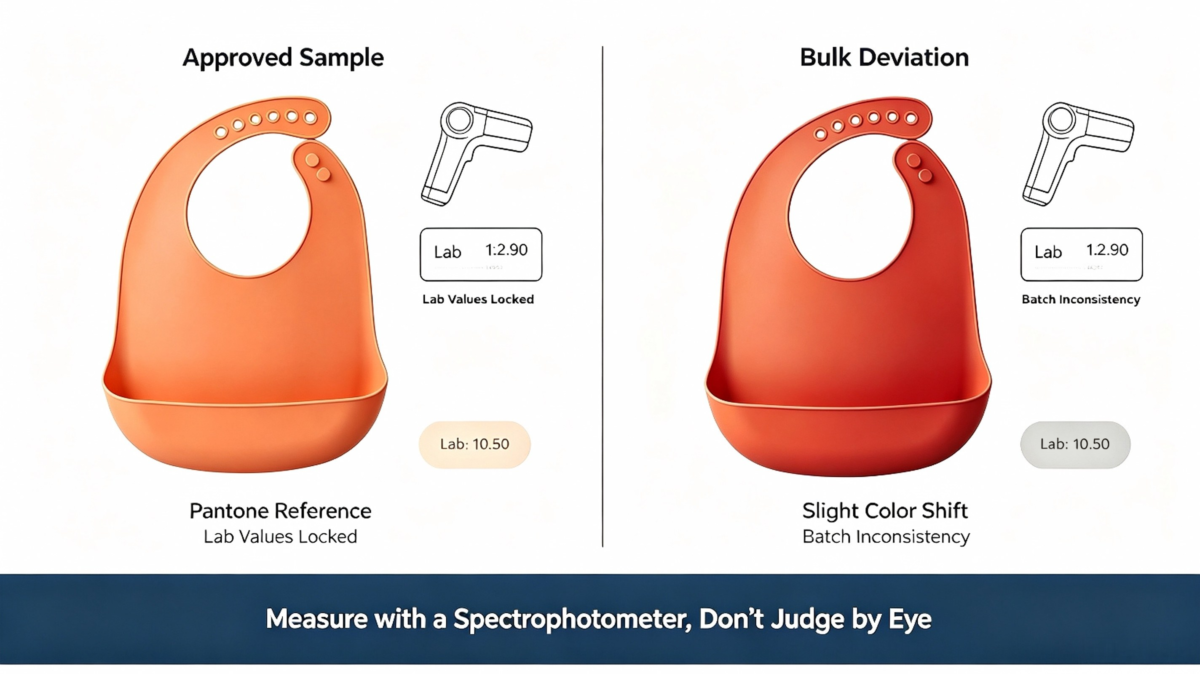
Eyeballing under one set of factory lights doesn’t catch any of this. What’s needed is spectrophotometer measurement — scanning the approved sample, generating a numeric Lab color value, then checking every bulk batch against that number with defined tolerance. If a batch reads outside range, it gets flagged and adjusted before it ships, not after a customer opens the box.
Muted, desaturated tones like Morandi colors are the most vulnerable to this kind of drift. There’s very little pigment saturation margin for error. A shift that would be invisible on a bright primary color is obvious on a soft sage or blush.
The Static Problem That Makes Products Look Dirty on Day One
Uncoated silicone carries a natural static charge. It’s just how the material behaves — it attracts dust, fabric lint, pet hair, anything fine and airborne sitting near it in packaging or on a shelf.
A properly finished product goes through a secondary surface coating after molding — a food-safe, anti-static layer that reduces that static pull and also gives the surface a smoother, less tacky hand feel. That coating step is what makes a product feel premium when a customer picks it up, instead of slightly sticky.
Skipping this step saves the factory time and material cost, and it’s invisible until the product sits somewhere with any airborne particulate — which is basically everywhere. A few days in a warehouse, a retail shelf, or even inside its own packaging, and an uncoated unit starts looking grubby, even though nothing is actually wrong with the silicone itself.
This matters across every category we produce. In custom silicone kitchen goods — baking mats, brushes, storage bottles — a tacky, dust-attracting surface is the kind of thing that generates one-star reviews about “cheap feeling” product, even when the material and mold quality are fine. In our silicone pet supply range, slow feeders and lick mats sit in environments with fur, food particles, and moisture, so surface finish affects both feel and cleanability. Coating isn’t decorative. It’s functional.

Why Baby Products Can’t Use the Same Coating as Everything Else
This is where the stakes go up considerably.
Any coating applied to a product going into a baby’s mouth has to pass migration and solvent-residue testing. The coating chemistry itself gets scrutinized — regulators want to know it won’t leach anything into saliva or transfer under normal chewing and sucking use. This is documented, testable, and tied to specific pass/fail thresholds under frameworks like FDA food-contact rules and LFGB testing in the EU. We’ve covered these standards in greater depth in our FDA & LFGB silicone certification guide — well worth reading if you’re sourcing any baby-contact silicone products for the first time.
The risk buyers don’t see: some factories apply one coating formulation across their entire catalog. They developed and tested a coating for general houseware, it performs fine on a baking mat, and they use the exact same coating on baby items in our baby silicone product collection because reformulating for a smaller order isn’t worth the hassle to them.
The problem is that houseware migration thresholds are more forgiving than infant-contact thresholds. A coating that passes for a spatula can still fail baby-specific migration testing. If a factory can’t show you separate documentation for the coating used specifically on baby-contact items, that’s not a paperwork technicality — it’s a real compliance gap that could surface at customs or, worse, after the product is already in a child’s hands.
What This Means for Your Next Purchase Order
Color and surface quality aren’t things you can verify by looking at a sample alone. They’re process outcomes — dependent on whether a factory measures instead of guesses, and whether they treat coating as a required step instead of an optional cost.
Quick Checklist for Silicone Color & Surface Quality
- Pantone reference locked in writing, with numeric Lab values, not just a visual chip match
- Bulk color verified by spectrophotometer, batch by batch, not eyeballed
- Cure cycle and oven parameters for bulk production confirmed to match (or account for) sample conditions
- Surface coating specified explicitly in the PO — finish type, anti-static function, food-grade status
- Coating verified as applied to bulk units, not just the original sample
- For baby-contact items: separate coating migration test documentation requested and reviewed
- For baby-contact items: coating formulation confirmed as different from general houseware, if applicable
- Pre-shipment inspection includes color deviation and surface tack/dust-attraction checks
If you’re working on a product line where color consistency and surface feel are core to how your brand reads on shelf, or if you need coating compliance handled correctly for baby-contact items, we’re glad to talk through how we manage it at Jarhouselife. No pressure — just an honest conversation about your specs and what’s realistic for your order.